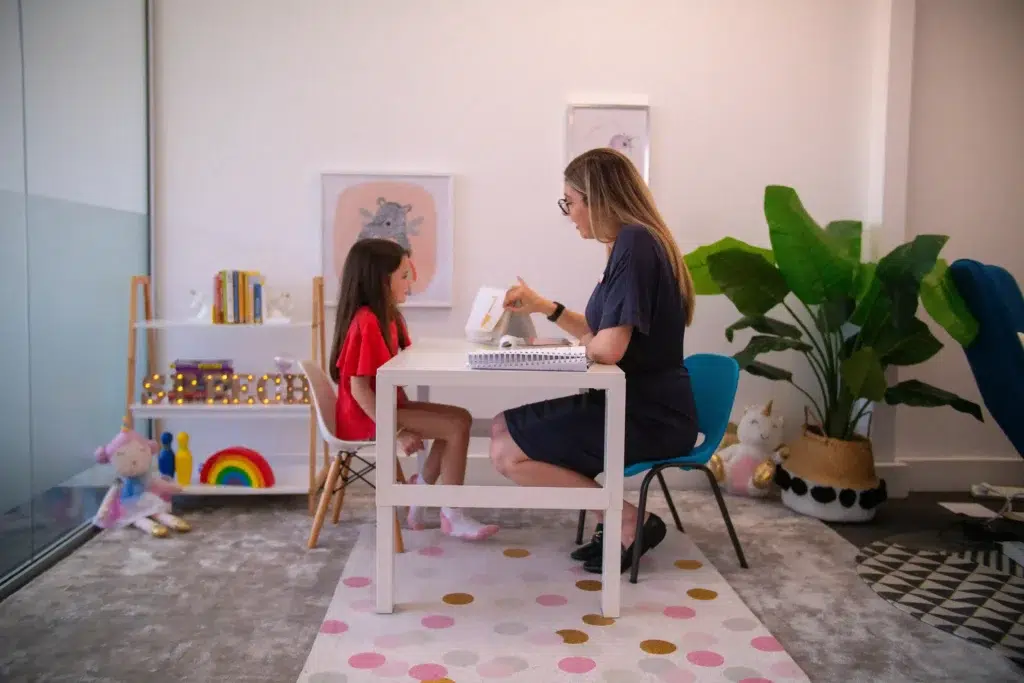
If your child is difficult to understand, or seems to be behind other children their age when it comes to talking clearly, you may be wondering whether what you’re seeing is just normal development or something that needs a closer look. Speech disorders in children are one of the most common reasons families receive a referral to a speech pathologist ¹. Fortunately, with the right assessment and treatment plan, most children make excellent progress ⁸.
In this article, we’ll walk through what speech sound disorders are and what causes them. Furthermore, we will explain how speech pathologists assess and treat these conditions, and where a specific approach called myofunctional therapy may or may not fit into the picture ⁴. As you’ll see, treatment is never one-size-fits-all. Instead, clinicians always shape therapy around the individual child ³.
What Is a Speech Sound Disorder?
A speech sound disorder is a difficulty producing sounds correctly for a child’s age ¹. Consequently, it affects how easily others can understand them. However, it’s important to distinguish this from the normal variation in how young children learn to talk. Most kids substitute, simplify, or mispronounce certain sounds as a typical part of development. Therefore, they often grow out of it without any intervention at all ¹.
Speech-language pathologists generally group speech sound disorders into two broad categories ¹:
-
Articulation disorders — difficulty physically producing specific sounds (for example, a lisp where ‘s’ is said as ‘th’).
-
Phonological disorders — difficulty with the broader patterns or rules of sound use (for example, consistently leaving off the ends of words).
Some children present with a mix of both, while others have related conditions such as childhood apraxia of speech ². This is exactly why a proper assessment matters. The label alone doesn’t tell you which treatment approach will help ³.
Signs of a Speech Sound Disorder in Children
Every child develops at their own pace. However, here are some general signs that may indicate it’s worth having your child assessed ¹:
-
Family members or unfamiliar adults regularly struggle to understand your child’s speech past age 3–4
-
Specific sounds are consistently missing, substituted, or distorted well beyond the age most children have mastered them
-
Your child seems frustrated or avoids talking because others do not understand them
-
Speech difficulties are affecting confidence, friendships, or participation at school
-
A teacher, doctor, or educator has raised a concern
If any of this sounds familiar, it doesn’t automatically mean something is “wrong.” Nevertheless, it gives you a good reason to book an assessment with a speech-language pathologist.
How Speech Pathologists Assess and Treat Speech Sound Disorders
When you bring your child in for an assessment, a speech-language pathologist evaluates several key areas ¹. They will look at sound production, oral-motor function, hearing, and broader language skills. Additionally, they assess how the speech issue affects daily life ¹, ⁸.
From there, clinicians build treatment recommendations using what’s known as evidence-based practice ³. This framework combines three core elements:
-
The best available research evidence
-
The clinician’s professional expertise and clinical judgment
-
The individual child’s assessment results, needs, and circumstances
This is a deliberately individualised process. Two children with a similar speech difficulty on the surface may end up with quite different treatment plans ¹. This happens because the right approach depends on the specific pattern identified during assessment, not a generic checklist.
Treatment options a speech pathologist might draw on include traditional articulation and phonological therapy techniques ¹. Additionally, they may use language-based approaches or supporting methods like myofunctional therapy, depending on what the assessment reveals ⁴, ⁷.