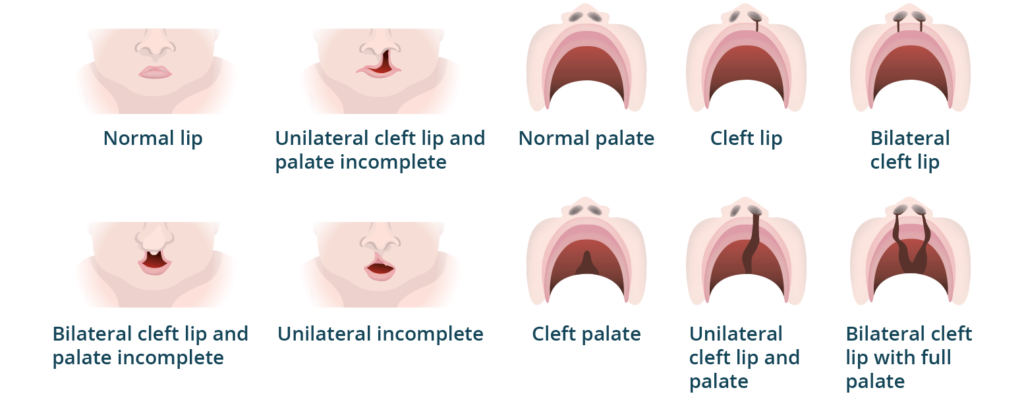
What are clefts?
Orofacial clefts are one of the most common birth differences. In fact, they occur in about one in every 700 births ⁹. The lip forms during the fourth and seventh week of pregnancy. If the tissue does not join completely, a cleft lip will develop ³.
A cleft lip can range from a small notch to a large opening. This opening extends from the lip up into the nose. Furthermore, it may affect one side (unilateral) or both sides (bilateral) of the upper lip ³.
Children with a cleft lip may also have a cleft palate. In these cases, the roof of the mouth fails to join completely during early development. Consequently, this creates an opening into the nasal cavity ⁴.
A cleft of the palate can be incomplete or complete. Therefore, it may affect only the soft palate or both the hard and soft palates ⁴. Ultimately, a child may present with a cleft palate only, both a cleft lip and cleft palate, or a submucous cleft ⁴.