
ClickCease
Speech pathologist holding up a picture card during a play-based session with a child, part of using sign language and speech therapy together

Sign Language and Speech Therapy: How Signing Supports Your Child’s Communication

Sign language and speech therapy are more connected than many parents realise. In this guide, we explain how signing supports communication, what the research says, and how a speech pathologist can help your child use signs alongside spoken words.

Will Sign Language Stop My Child From Talking?

This is the most common worry parents bring to us. The logic seems simple: if a child can sign “more”, why would they bother saying it?

The research does not support this fear. A 2023 study of deaf and hard of hearing children found that learning a sign language did not harm spoken vocabulary development ¹. Earlier research with hearing babies found that children taught symbolic gestures did not fall behind in spoken language, and some showed small early gains ².

It is also fair to say the evidence on baby signing has limits. A systematic review found few high-quality studies and no clear proof that baby signs speed up spoken language in typically developing children ³. In short, signing is unlikely to hold your child back, but it is not a shortcut to talking either.

Why doesn’t signing get in the way? Because signs and words both build the same foundations:

  • Turn-taking: your child learns that communication goes back and forth.
  • Understanding: a sign paired with a word gives your child two ways to grasp its meaning.
  • Success: when a sign works, your child learns that communicating gets results, which builds motivation to keep trying. Signing can also help children communicate their message quickly (especially if the word has later-developing sounds), which can reduce frustration or tantrums.

Most children drop signs naturally once spoken words become easier and faster for them.

Sign Language vs Speech: What’s the Difference?

To understand how sign language and speech therapy connect, it helps to separate two ideas: language and speech.

  • Language is the system we use to share meaning. It includes words, grammar and understanding what others say.
  • Speech is the physical act of making sounds with the mouth, tongue and voice.

Sign language is a full language. It uses the hands, face and body instead of the voice. In Australia, the language of the Deaf community is Auslan (Australian Sign Language), which has its own grammar and vocabulary.

This matters because a child can have strong language skills through sign while still working on speech sounds. Speech pathologists assess both. Supporting language in any form, signed or spoken, builds the foundations your child needs to communicate.
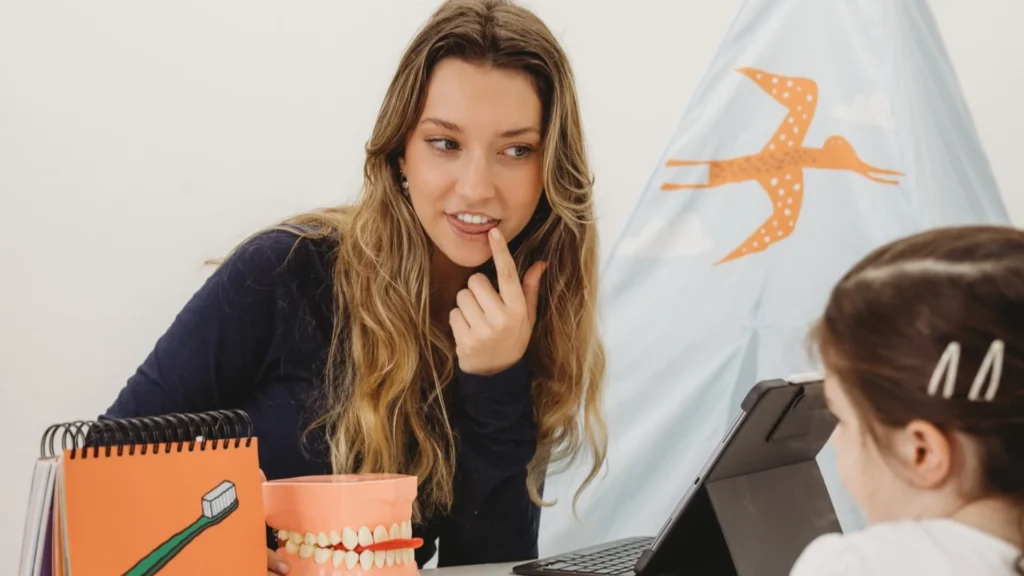
Speech pathologist modelling mouth movements for a child, a visual cue used alongside sign language in speech therapy

How Speech Pathologists Use Sign Language

In sign language and speech therapy, signs are one tool among many. How a speech pathologist uses them depends on your child’s needs and your family’s goals. Common ways include:

  1. As a bridge to spoken words. Signs give a child a way to communicate before words are ready. The therapist always pairs the sign with the spoken word, so the child hears it every time.
  2. As part of AAC. Augmentative and alternative communication (AAC) covers any method that adds to or replaces speech, such as signs, pictures or speech-generating devices. Signs are often called “unaided” AAC because they need no equipment. In Australia, speech pathologists may use Key Word Sign (KWS), which borrows signs from Auslan to support the key words in a sentence ⁴.
  3. To support understanding. Signs are visual and stay in the air longer than a spoken word. This can help children who find it hard to follow spoken language.
  4. To reduce frustration. When a child can get their message across quickly, there are often fewer meltdowns at home.
  5. To coach parents. A big part of therapy is showing parents how to use signs during everyday routines, so practice happens far beyond the therapy room.

Sign Language for Deaf and Hard of Hearing Children

For deaf and hard of hearing children, sign language is often more than a support tool. It is their language.

Many Australian families choose a bilingual approach, where their child learns both Auslan and English. Research commissioned by Deaf Connect and Deaf Australia found that early access to Auslan supports language development, emotional wellbeing and a strong sense of identity for deaf children ⁵. Deaf Children Australia also notes that bilingual Auslan and English programs can help children build skills in both languages from a young age ⁶.

Speech pathologists often work as part of a wider team in this space, alongside audiologists, Teachers of the Deaf and Deaf mentors. Their role may include:

  • Supporting spoken English, listening and speech sounds where that is a family goal
  • Building overall language skills, whether signed, spoken or both
  • Supporting early literacy
  • Helping families choose a communication approach that fits their child

The right approach is a family decision. A good speech pathologist will respect your choices and help you make an informed one.

Signing for Late Talkers and Complex Communication Needs

Sign language and speech therapy also work well together for hearing children who find talking hard. Signs may help:

  • Late talkers: toddlers who understand a lot but say few words. Signs give them a way to share what they know while spoken words develop.
  • Autistic children: some children find visual communication easier to process than spoken language. Signs may be used alongside pictures or devices.
  • Children with Down syndrome: signing is widely used to support early communication, as speech often develops later.
  • Children with childhood apraxia of speech (CAS): CAS makes planning mouth movements for speech difficult. Signs let a child communicate while they work on speech in therapy.

For these children, the goal is not to choose between signs and speech. It is to give them every possible way to connect with the people around them. A speech pathologist will look at your child’s strengths and decide which tools, signs included, will help most.

Tips for Using Signs at Home

You don’t need to be fluent in Auslan to start. A handful of useful signs is enough. Try these tips:

  1. Always say the word as you sign. Never sign in silence. Your child needs to hear the spoken word every time.
  2. Start small. Pick three to five signs your child will use daily, such as more, finished, eat, drink and help.
  3. Use signs in routines. Mealtimes, bath time and play are perfect moments for practice.
  4. Sign near your face. This helps your child see both your hands and your mouth.
  5. Celebrate any attempt. A rough version of a sign counts. So does a sound or part of a word.
  6. Be consistent. Ask grandparents, carers and educators to use the same signs.
  7. Look up Auslan signs. Using real Auslan signs means your child learns signs others will recognise. The free Auslan Signbank dictionary is a good place to start.

When to See a Speech Pathologist

Signing at home is a great start, but it is not a replacement for professional support if you have concerns. Consider booking an assessment if your child:

  • Is not babbling or using gestures like pointing and waving by around 12 months
  • Uses very few words by 18 months to 2 years
  • Is not combining two words by around 2 years
  • Is hard for family members to understand
  • Has lost words or skills they used to have
  • Has a hearing loss or you have concerns about their hearing

If you’re worried about your child’s hearing, ask your GP about a hearing test as a first step.

Reference

  1. Caselli, N., Pyers, J., & Lieberman, A. M. (2023). Learning a sign language does not hinder acquisition of a spoken language. Journal of Speech, Language, and Hearing Research, 66(4), 1291–1308. https://doi.org/10.1044/2022_JSLHR-22-00505
  2. Goodwyn, S. W., Acredolo, L. P., & Brown, C. A. (2000). Impact of symbolic gesturing on early language development. Journal of Nonverbal Behavior, 24(2), 81–103.
  3. Fitzpatrick, E. M., Thibert, J., Grandpierre, V., & Johnston, J. C. (2014). How HANDy are baby signs? A systematic review of the impact of gestural communication on typically developing, hearing infants under the age of 36 months. First Language, 34(6), 486–509.
  4. Raising Children Network. (n.d.). Key Word Sign. https://raisingchildren.net.au/autism/therapies-guide/key-word-sign
  5. Per Capita. (2023). Exploring the benefits of Auslan in early intervention approaches for deaf children [Report commissioned by Deaf Connect and Deaf Australia]. https://deafconnect.org.au/wp-content/uploads/2023/09/BENEFITS_OF_AUSLAN_EARLY_INTERVENTION_DIGITAL.pdf
  6. Deaf Children Australia. (n.d.). The power of connection: How Auslan empowers deaf and hard of hearing children.